The work is best carried by the organisation's own people, with external guidance available at the points where it is needed. Learning by doing.
Four engagement tracks, each engaged when needed and stepped back from when not. The goal is a converged condition the organisation operationally owns, not a set of deliverables completed.
The work is best carried by the organisation's own people, with external guidance available at the points where it is needed. Learning by doing.
A structural diagnosis of where the organisation stands against the three governance mandates – fidelity of representation, safety of action, integrity of their interaction – and against the three foundations that must serve them. The assessment identifies where authority is held, where it is absent, and where the three governance myths are operationally active and producing exposure the organisation has not yet recognised as such.
Produces a Governance Position Report with mandate coverage, foundation state, myth exposure, the scoped governance void, convergence knowledge gaps, and the entry point for the Transition Path.
The path from ungoverned convergence to governed operation, sequenced for the organisation's specific starting condition. Grounded in the dependency logic that makes formalised authority the precondition for allocated decision rights, and decision rights the precondition for encoded architectural control. Names the common failure mode: architectural work that outpaces the governance to sustain it.
Produces a Transition Path with structural progress indicators – binary conditions tested by whether each foundation has been used under operational pressure, not whether it has been documented – and the TGB readiness position that gates implementation.
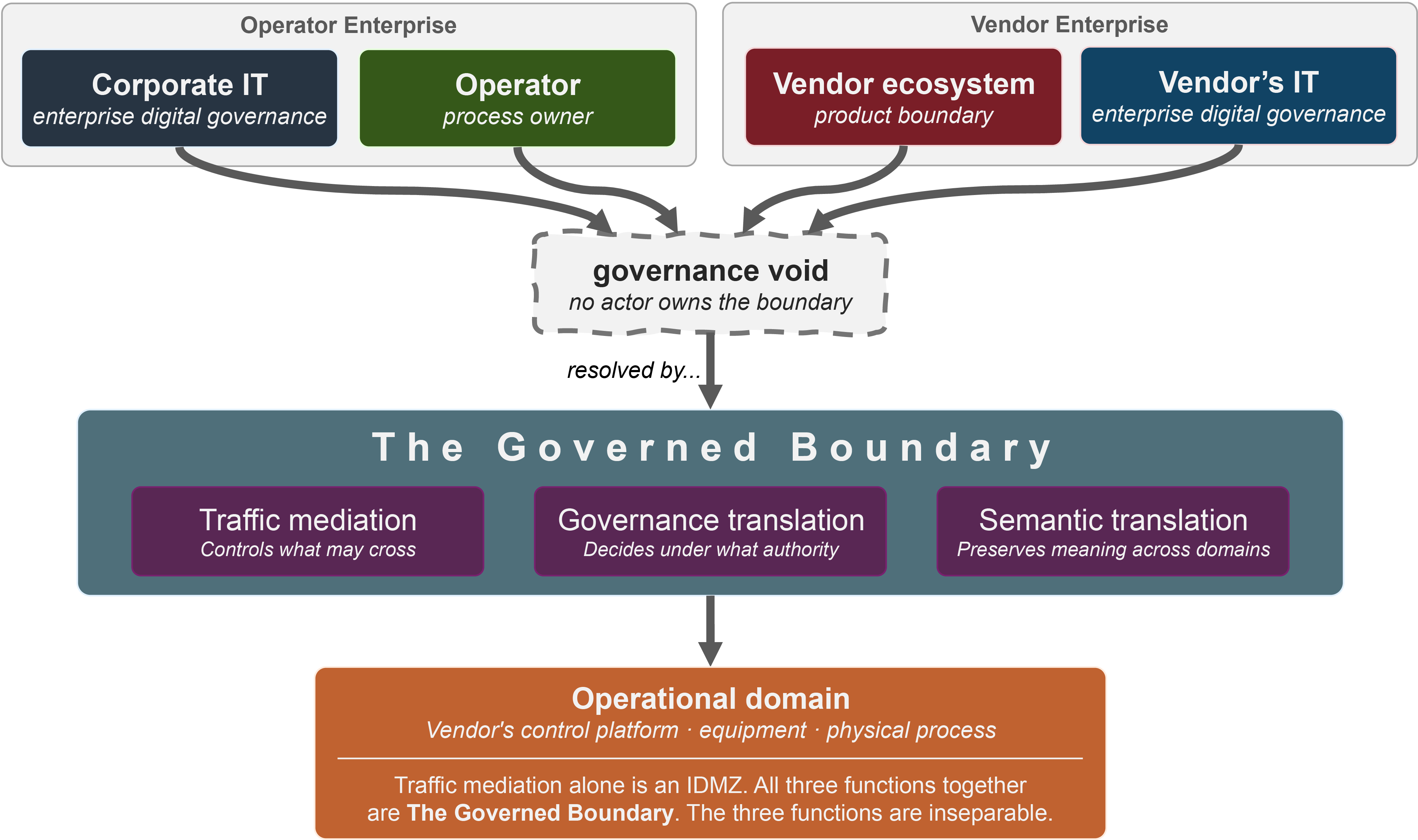
A precise evaluation of what the boundary architecture actually does, measured against the TGB specification rather than against the IDMZ standards a network-segmentation review would pass. Tests for traffic mediation, governance translation, semantic translation, vendor containment, and monitoring as a boundary function.
Produces an Architectural Position Report mapping the eighteen capabilities and naming each mediation condition – governed, vendor-unilateral, unmediated. Identifies every collapsed-boundary instance where vendor platforms straddle the boundary, and quantifies the gap-to-specification. Can run independently or alongside Engagement 1; feeds Engagement 4 directly.
The path from architectural specification to built reality at a specific site. Brownfield is the usual starting point, and the strategy classifies the site against three migration patterns: from a flat network, from an existing IDMZ, or from a vendor-managed estate. Capability sequencing follows the architectural dependency: mediation first, identity next, semantic translation after, monitoring throughout.
Produces a Site Implementation Plan with the OT reference architecture confirmed, the vendor landscape assessed, the conduit governance regime, the phased sequence around operating constraints, and the exception register. Grounded in current field work.
Most organisations recognise one of three starting patterns:
Convergence has arrived but no governance framework addresses it. The governance void is unscoped and the exposure unmeasured. Track 1 is the entry point.
Boundary infrastructure exists – firewalls, segmentation, perhaps an IDMZ – but governance does not. The architecture does traffic mediation without governance translation or semantic translation. Track 3 is the entry point.
Policy exists, governance intent has been expressed, but the architecture has not kept pace. The gap between governance aspiration and architectural reality is the dominant risk. Track 2 is the entry point.